Sunday, May 13, 2012

Forgetting History


We were in Central Park as usual and happened to come up on the park's vintage carousel just a few minutes before it opened for business. We never pass up easy opportunities to delight our toddler, so we bought tickets and went aboard, the first customers of the day.

Elizabeth looked doubtful as we went in. Her doubt turned to alarm when she got a closer look at the garish decor. Alarm became fear when we tried to sit her on one of the fierce looking horses, recently repainted in extra vivid color. And fear grew to desperate terror when they cranked up the calliope music, a sound you only hear nowadays in the nightmare sequences of horror movies.

Here she is, begging to get off the merry-go-round, but by this time we were under way and just had to comfort her as best we could until the ride was over.

What was I thinking? I was a toddler once myself and remembered too late exactly how she felt. The years fell away and I was three years old again, clinging to my mother's hand on a sidewalk in downtown Monterrey, California, as a large, ungainly figure approached us.

"Oh, David, look," Mom said. "It's Mr. Peanut."

I was a big fan of Planters and quite familiar 
with their distinguished spokespeanut with his jaunty monocle and top hat. But he was a tiny little guy on the peanut can. The creature now looming over me was nearly seven feet tall.

I retreated behind my mother's skirt, hid my face and ignored her as she urged me to introduce myself to Mr. Peanut and shake his hand. Mr. Peanut evidently had mascot training that didn't allow him to say anything, which somehow made him seem even more frightening. They both finally gave up on me and we all went on about our business.

But that night I reflected on the incident in my bed as I was trying to go to sleep. I had come face to face with the actual Mr. Peanut. I could have shaken his hand and told him how much I liked his product. Maybe I could have learned interesting behind-the-scenes stuff about being a walking peanut. He might have even given me some free nuts. I realized with chagrin that I had let fear deprive me of an important opportunity.

The memory made me braver as I got older. Maybe Elizabeth will have a similar outcome. After shaking off her heebie-jeebies, she almost let us take her on for another ride. But then she shook her head, so we went on to the playground instead.

Thursday, May 3, 2012

Home Is Where the Sofa Is


Manhattan is lousy with real estate offices, and all of them put photo collections like the one above in their display windows so people can see what's for sale. There's hundreds more every week on websites and glossy magazine pages.

Every time I see them I shake my head, because of course the photos don't show what's for sale at all. They're just pictures of other people's furniture. If you took away the stylish sofas, chairs and grand pianos and all the expensive rugs and artwork, most of these rooms would look pretty much the same in their closeups, which is to say not very good.

Your average New York apartment across all but the highest price ranges is plaster walls, wood floors, factory-made window frames, and small, merely serviceable kitchens and bathrooms. Until you trick them out with your own stuff, they're just white space, dwelling dummies.

Real estate is always said to be about "location, location and location." But in other places the location is a lot more likely to have some intrinsic character to it, some essence that makes up part of the core of the value you imagine you're acquiring when you take ownership.

Not here. The value you acquire when you buy in Manhattan is nearly all extrinsic to the property itself, starting with the fact that it happens to be in Manhattan and going on with its distance from work, transit, shopping, schools, night life or whatever else you think is cool.

Those are key considerations when you buy a home anywhere of course. But whereas elsewhere they're likely to be ancillary, here they're the whole ball game. The apartment is not where you live. It's only a staging area for your actual life which is conducted in other places.

So it's curious that New Yorkers obsess over real estate more than anybody else I know. Wherever you go, you can overhear people complaining about their condos and co-ops and talking about their searches for different space.

I suppose what happens is that people keep buying more furniture, so they eventually need more room to keep it in. This would also explain why brokers sell apartments with photos that do nothing but demonstrate their usefulness as storage facilities for personal property.


Sunday, April 22, 2012

Binoculars


Elizabeth was born cockeyed. No disrespect intended to her state of mind. She has a common vision defect which causes her left eye to wander occasionally outward.

It's a pretty subtle thing, and I never even noticed it. Pam did, though, and when we went to the pediatric opthamologist, he just said, "Oh yeah."

The condition is called strabismus. Its common name is "lazy eye," but according to Wikipedia, "Other names include 'squint,' 'crossed eye,' 'google eye,' 'boss eye', 'cock eye', 'wonk eye', 'cod eye,' 'derby eye,' 'waz eye,' and 'wok eye.'

Nobody wants to hear any of those from the other kids on the first day of school, but the real reason for getting strabismus treated is that it impairs depth perception, which leads to clumsiness and lack of confidence. Worse yet, the brain may begin ignoring signals from the wayward eye entirely, effectively leaving it blind.

Under doctor's orders, we tried patches and then drops as a means of blanking out or fuzzing up the good eye and forcing E's brain to exercise the muscles around the troublesome one. None of that worked, so last week we bit our lips and took our tiny one to the hospital for surgery. The doctor had explained he needed to loosen the muscles on the outsides of both eyes to make it easier for the brain to align them.

I drew the short straw and went into the operating room to be with E until she was knocked out. We were both cool until the anesthetist put the mask over her face and she began to struggle and cry. My job was to comfort and restrain her for the seconds it took for her to go to sleep.

Those were some of the hardest moments of my life. She was so small and so scared, these people were strangers, and she trusted me. When her eyes finally closed and she relaxed onto the table, I choked out an incoherent "Do your best" to the masked marvels who were already going to work and hurried from the room feeling like I'd let everybody down.

The whole thing only took 45 minutes. The doctor told us it went perfectly, which was good to know because her eyes were shockingly bloodshot and she was now a bit cross-eyed. In the post-op exam a couple of days later, the doc said this was exactly as it should be. The loosened muscles will grow stronger in the weeks ahead and pull both eyes back to center.

He also said something else. "My team does 20 of these procedures a day, and they were really impressed with the way you and Elizabeth handled yourselves in the operating room. You really made an impression on them."

I am proud of us both. Even better, as you can see above, she's still smiling at me.

Sunday, April 15, 2012

Bottomless Grief


Walking my cousin Judy around lower Manhattan Sunday morning, we found ourselves close to the 911 Memorial. You used to have to reserve a time slot for a visit weeks in advance online, but now your chances are pretty good of getting a ticket on the spot. Judy lives in Rhode Island and hadn't seen it yet, so we got on the short line and went in with her.

For all the agita that marked the process of deciding what should be done at the site, the memorial now seems inevitable, as if this had been the only way the fall of the towers and all it meant could have been commemorated, though of course there were certainly other possibilities that could have turned out just as well or maybe better. This is the one that was chosen and built, and the one visitors now include among highlights of their time in New York.

The picture above shows what used to be the footprint of the North Tower. It's now a square pit with water cascading from its rim into a pool far below, then flowing into a second smaller square chasm whose depths can't be seen from ground level. There's an identical downward fountain on the South Tower footprint.

The designers certainly must have had some specific intentions for what visitors would think and feel as they stand around the edges and watch the water fall and flow into the darkness. But in a memorial as vast as this one, I expect the most lasting impressions are random and personal.

It was windy on Sunday, and strong gusts played hard across the face of the cascades, turning their vertical streams into rhythmic horizontal waves of spume that sent clouds of fine white spray over viewers on the downwind side. As John Lennon is supposed to have said, "Life is what happens while you're busy making other plans."

Pam noticed that if you reach down below the stone barrier where the names of the dead are inscribed, you can put your fingers into the water before it begins its descent. "Touch it," she said to Judy. "It feels like you're touching the movement of the universe."

Sunday, April 8, 2012

Safety in Numbers


I'm used to being asked by friends and relatives if I feel safe. I live in New York City, though not for much longer. I'm moving to Puerto Vallarta on Mexico's Pacific coast.

People who don't live in New York tend to think it's a nice place to visit but they wouldn't want to live there, even though annual reports on crime statistics for decades have ranked New York among the safer cities in the country.

And even fellow New Yorkers look askance when I tell them about our plans for moving to Mexico, where drug wars and kidnaping seem to be the leading industries if you go by what you read in the news. They ask if we have any concerns about security, though what they're really asking is what can we be thinking.

But what I've noticed about the most murderous criminal outbursts in my own country is that they don't happen on the darkened streets of New York or any of the other biggest cities.

They happen on quiet college campuses in Oakland or in Blacksburg, VA. On a military base in Texas. In a high school in a predominantly white Colorado exurb.

There may have been a time when such locations would have seemed remote from the alienation, poverty and social disfunction that used to seem like the root causes of violence. But that's not how I look at them now. I see them as insular, culturally monochromatic places where there is enormous pressure to fit in and measure up.

I think you're less likely to find yourself ducking for cover to avoid becoming a victim of random mayhem in a place where oddness, ugliness, incapacity and failure are taken for granted as readily as their more comely opposites.

Thursday, March 29, 2012

A Tyrant Is a Person In My Neighborhood


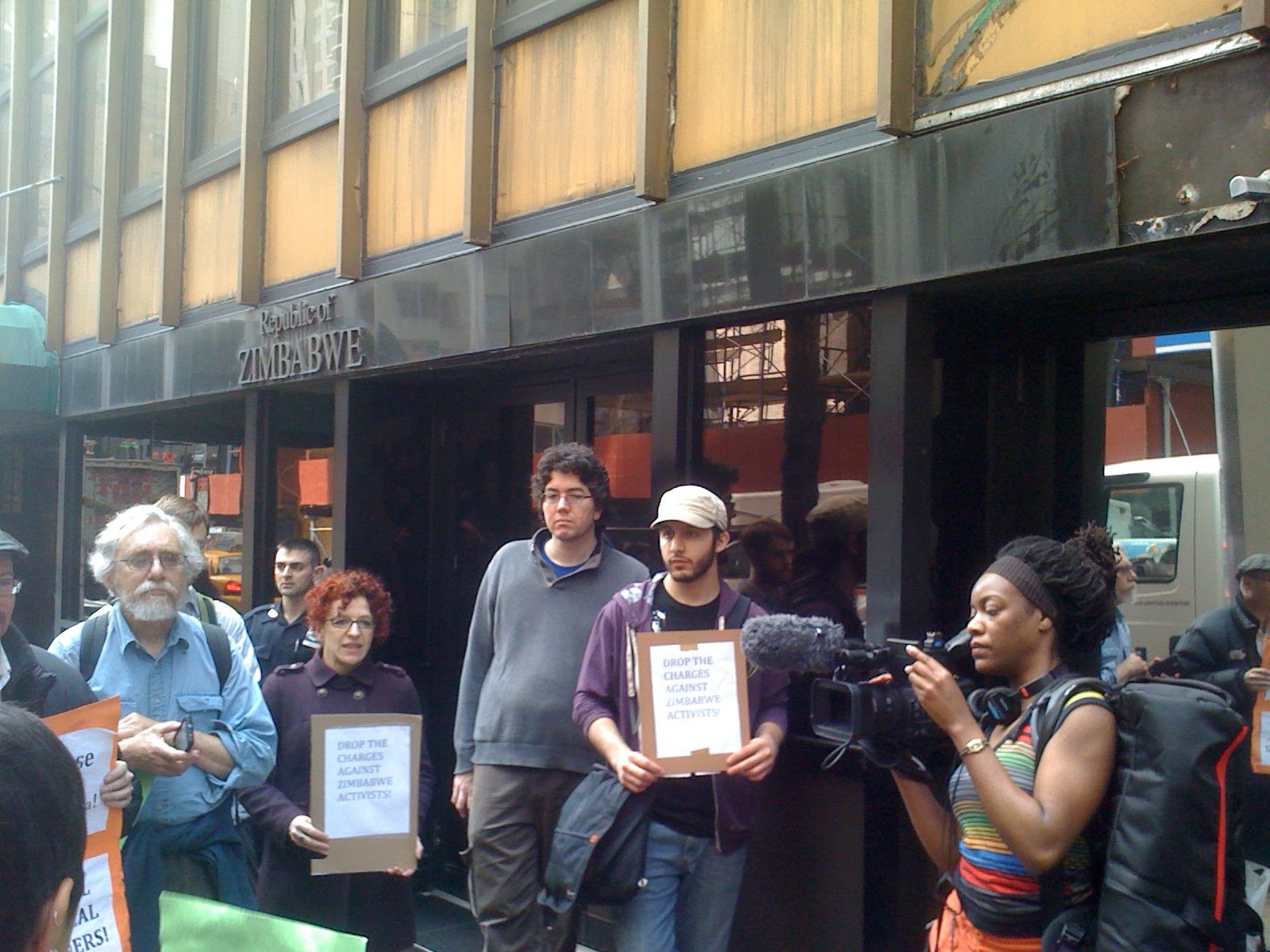
This shameful address is about a half block from the building where I live on E. 56th Street. Walking past it you'd think it was a derelict waiting for a wrecking ball. The street level windows are either blacked or covered in chipped reflector sheets. I've never seen anybody go in or out.

On the dark strip above the blank facade, it says "Republic of Zimbabwe" in letters so faded and worn that it looks like the real sign was taken down years ago and all that's left is the outline of the letters. All in all, it's just the sort of place where you'd expect to find the consulate of a government that has to wear a bag over its head when it goes abroad.

The "Republic" of Zimbabwe is one of the sad places in our world where an entire people is held hostage by its so-called government, a corrupt and barbaric entity consisting of the so-called president, Robert Mugabe, and his loathsome clique of military, police, and their favored private sector cronies, all feeding greedily on the resources of the land and its miserable occupants.

The world doesn't pay much attention because the regime does its brutal best to strangle news about what really goes on there. Among the tools it uses is a national law that gives authorities the right to control and suppress the few news organizations that manage to operate in Zimbabwe, both domestic and foreign.

Rather than accept the terms of the statute, AP decided many years ago to close its bureau in Harare and cover the country with a combination of courageous local freelancers and listening posts in neighboring countries. That hasn't stopped the regime from hounding those journalists, especially at election time, with home invasions, detentions, searches, brutal interrogations and threats of worse.

There are certainly blacker holes on the planet. The Mugabe evils are routine and familiar, made more so for me by this closed fist of a building that I often pass on the way to enjoy the flowers in Central Park. I was doing exactly that earlier this month when I encountered these people, the first sign of life I've ever seen around the place.

They were protesting the arrest, detention and torture of 45 people in February for the crime of watching videos of the Arab Spring in Egypt, Tunisia and Libya. In places like Zimbabwe, information is sedition.

I snapped my picture and went on about my business feeling inadequate. Lines from the James Russell Lowell poem "Freedom" came back to me from school days:

True Freedom is to share
All the chains our brothers wear,
And, with heart and hand, to be
Earnest to make others free.


Thursday, March 15, 2012

Retail Recreation


This stately madhouse is the lobby of what used to be the Williamsburg Savings Bank in Brooklyn, at one time the borough's tallest building, though it's in Boerum Hill, not Williamsburg.

The people who commissioned those lofty arches and gilded mosaics certainly never foresaw that one day the space would be harboring a flea market every weekend, but they probably should have. The urge to go shopping strikes me as the biggest single explanation for human aggregations larger than clan-size, and any space large enough to accommodate a market is eventually destined to become one.

It Science is still trying to pin down what distinguishes us from the other beasts, maybe they should consider the will to haggle and trade as uniquely human traits, although it's an astonishing world and I wouldn't be surprised if there are other primates or maybe even some obscure tree frogs or wasps who discovered the joy of buying and selling before we did.

Call it recreation, call it therapy, call it wealth creation, call it a way of life, it's what we do. In a big city, most of your street level surroundings and the visible comings and goings concern facilitation, pursuit and execution of retail purchases. Love is very nice, but it doesn't make the world go 'round. It's the urge to acquire more stuff that keeps things moving.

I was first struck by how urgent and primal the shopping instinct is many years ago when I had to organize a small editors' conference in Sumter, SC. I was told the agenda shouldn't be so tight that it couldn't accommodate some free time for retail therapy.

Sumter was tiny, and the only place to go for that was a shabby strip mall at the edge of town, anchored by a grocery store. But people packed a couple of shuttle vans for the chance to browse the fabrics and notions, greeting cards, pet supplies and hardware that were about all you could buy there. They returned only mildly disappointed, which told me they weren't expecting much to begin with but just needed to do it.

When you're younger, it's about the stuff. You imagine when you've bought it, you and your life will be transformed in some way. Later you realize that this isn't true, but it's too late, you can't quit.

Paul McCartney sang it best: 'Buy, buy' says the sign in the shop window. 'Why, why' says the junk in the yard.

That's from "Junk" on his debut solo album "McCartney." If I ever see it at a flea market, I'm gonna buy it.