Tuesday, February 11, 2014

Shirley Not


We're not telling Elizabeth that Shirley Temple just died. Is that wrong?

Maybe we'll talk about it some more and change our minds. But right now Pam seems pretty sure we shouldn't, and she's taken a lot more psychology a lot more recently than I have.

Elizabeth likes Shirley a lot. Last year Pam ordered a DVD three-pack consisting of Heidi, Little Miss Broadway and Curly Top. I've watched them all with her dozens of times.

We enjoy Curly Top primarily for the "Animal Crackers In My Soup" number, which is charming except for the line that goes "I stuff my tummy like a goop with animal crackers in my soup."  What on earth did "goop" mean, or was it just a cheap dodge for a writer who had run out of rhymes for soup?

My favorite of the three is Little Miss Broadway. I once read that it did poorly at the box office. But I think it showcases better than the others the astonishing show business package that Shirley Temple really was.

Her dance numbers with the talented though odd looking George Murphy are virtuoso performances for both of them. But she was hardly more than a toddler, whereas he had become so noted for his jiggling and dancing that California would soon send him to the U.S. Senate.

Shirley Temple's acting is remarkable too, full of small expressions and gestures that reflect maturity and experience far beyond her years and yet seem natural, not precocious as they often do with other child actors who have obviously been coached.

So Elizabeth and I are both big fans of Shirley the child star.

But Pam and I have hardly talked with E at all about the fact that Shirley Temple grew up and did a lot of other important though less famous things and was now an actual old lady with a family and a life that had nothing to do with being a make-believe orphan in movies made long ago.

I thought her death might be a good way to begin educating Elizabeth on the delicate subjects of grief and loss in a way that might help prepare her for the day they hit closer to home.

But no, Pam said,  it would only be gratuitous trauma if it was anything at all. And before we could inflict it we'd have to talk about fantasy characters versus the real actors behind them and try to give her a sense of the previously unknown and now deceased Shirley Temple Black. Before telling her she's dead.

In Pam's view, if Elizabeth didn't fall asleep in the middle of all this strained, self-conscious parenting, what's the point?

I admitted that the benefit I saw was entirely notional. I am as ignorant of how her little mind works as I was the day she was born.

One thing I am pretty sure of, though, is that she's farther along than we might think in distinguishing imaginative experience from real life.

This morning she was eating breakfast with her cheap but cherished inflatable Dora the Explorer that we got her a few days ago and from which she's been inseparable, day and night.  We were talking about the little homework task she'd done for school the night before.

"I don't think Dora's done her homework," I playfully remarked.

"Daddy," she said, in a way that conveyed some surprise that she had to set me straight on this. "Dora doesn't get homework. She's a balloon."

Saturday, February 8, 2014

Slang Blade


The other day a neighbor who is trying as hard as I am to improve her Spanish asked me if I knew what changuitos means.

Elizabeth told me some while back that chango means monkey, and since "ito" often turns a noun into its diminutive, I had my answer. "Little monkeys," I said.

Not bad, but not quite right. Some word player in the dim past noticed that two crossed fingers looks like a couple of tiny monkeys, and today changuitos in the right context is slang for "crossing my fingers," or "I hope so."

There's language for you. You might think after you've got 100 "power verbs" and the past and future tense under control that you'll be mistaken for somebody who really knows how to speak it. The fun hasn't even started.

Actually, I already had some vernacular for "I hope so." Around here and no doubt throughout the Spanish speaking world they say "ojala" -- accent on the last syllable and the j pronounced like a guttural h -- to express "a wish for a future event to occur."

That's quoted from the Wiktionary definition of the Arabic "inshallah," which translates more or less as "if God wills it." So ojala descends from one of the cultural fragments left behind when the Spaniards evicted the Moors, and now they've all got millions saying it in Mexico, including expats like me.

Basic Spanish is certainly pleasing to the ear, but like any other language its real richness lies well beyond the scope of any conversational course.

Browsing a list of slang I came across online, for example, I found a cluster of expressions involving the egg. The word "egg" is used among other things as a stand-in for cojones or balls, which I am guessing is why the phrase "a huevo" can mean "by force."

In polite company, you can substitute "a producto de gallina" (by hen product) or even "a producto avicola" (by avian product) to use the same crude metaphor.

Mexicans are at least as good at euphemism as we are. Reading Noticias Puerto Vallarta, a local online news site, I came across a story last week about a drunk arrested on the beachfront malecon after he had disrobed in broad daylight, treating onlookers to a full frontal view of his partes nobles.

Like "egg," the words for mother (madre) and father (padre) are powerfully symbolic and have produced their own families of slang expressions, some seemingly at odds with each other.

"A toda madre", for example, means great. But "una madre" is "a nothing, a zip, a zilch." I picked up the commonly heard "que padre" from a Spanish classmate last year and feel bold enough to use it now and then. It means "how cool," and if you're really enthusiastic about whatever it is, you can say "padrisimo."

I found a lot of speculation but no authoritative last word on why the street likes adapting words like these so often for so many purposes. But there are plenty of other expressions that are obvious.

For example, the phrase "ponte las pilas" translates literally as "put on your batteries," but the better translation is "get a move on."

Borrar means "to erase." Making it reflexive turns it into borrarse, which translates as "to erase oneself." You might use that verb to mean "to make oneself disappear" or in the equivalent English slang, "to split."

I found another infinitive in the newspaper the other day that appears in the dictionary as an ordinary verbal citizen, but my theory is that it started long long ago as slang.

The news story was about the wreck of a small plane and the death of its two passengers. The verb is "estrellarse." The word estrella means star, so the verb seems to mean literally "to star oneself." In the dictionary, however, it means to crash or smash into something, i.e. to go splat.

That seems disrespectful of the feelings of the bereaved, but I'm practicing etymology without a license and had better stop now.

Tuesday, February 4, 2014

Keeping It Real


There's a certain kind of tourist who prides himself on refusing to be satisfied with the synthetic brand of experience on offer in a place like Puerto Vallarta, who looks for the road less traveled where he can see and do what real locals do. I think I've mentioned this before.

Others have noticed too. Puerto Vallarta is ready to accommodate these special people. About an hour south of here is the town of El Tuito, which several of the self-styled travel curators who blog about these parts have certified as a taste of "the real Mexico."

I suspect many actual Mexicans would be discouraged to learn this. El Tuito is a dusty agrarian county seat with a population just shy of 3,000. It has a charming little town square and a modest church, but I can't think what would make it more authentically Mexican than anywhere else.

We live alongside Vallarta's own central plaza and principal church, and when we want to see weatherbeaten masonry, crumbling municipal infrastructure and loose chickens, we don't need to drive 40 miles into the hills. We can just look out the window.

Not that we didn't think our recent visit to El Tuito was worth the trip. It was, and for that matter the trip itself was worth the trip.

The highway south skirts the bay and offers panoramic Pacific views at every turn, all the way to Mismaloya where Night of the Iguana was filmed and beyond to Boca de Tomatlan, where you can catch a water taxi or hike the rugged cliff and jungle trail to the more remote beaches.

The road then veers away from the coast into the heights of the Cabo de Corrientes peninsula, which defines the southern edge of the vast Bahia de Banderas. As you go up, rain forest abruptly turns to long-needled pines. By the time you get to El Tuito in the center of the cape, you've climbed 2,000 feet and the air is noticeably cooler.

We went no further, but one of the best reasons for making the drive is that if you turn west off the highway onto one of the sketchy roads out of town, you eventually reach Mayto and the other beaches where there are only a couple of tiny hotels and literally nothing else but trackless sand and crashing surf as far as the eye can see. That's on our to-do list for sure.

El Tuito and its environs live mainly on farming of sorghum, agave and other row crops, raising livestock and the distilling of raicilla, which is tequila's evil twin. They also make panela, one of the soft, mild cheeses Mexicans favor.

But gringos who go there because they like to congratulate themselves on getting off the beaten track will be disappointed to learn that El Tuito isn't content with its relative obscurity and would be glad to trade its tranquility for more tourists.

The largest raicilla distillery now has its own boutique inn, the panela factory gives tours, there's a patio restaurant on the square that earns Tripadvisor stars, and also a tidy little cultural center with one of those colorful indoor murals featuring heroic effigies of historic figures that adorn public buildings all over Mexico. That's it pictured above.

What's "real" to me about travel is that wherever in the world you go, you find people trying to make a living the best way they can with whatever resources and skills they can bring to bear.

In places where those happen to be meager, it strikes me as curious at best that some visitors feel the impulse to hype and romanticize the resulting struggle to get by.

Sunday, February 2, 2014

Love and Death in Mexico


In every rodeo I ever saw, a cowboy who wants to take down a running steer dives off his horse onto the animal's neck and twists its head by the horns until it falls over. But Mexican charros dress much fancier and prefer not to leave their saddles, so they do things differently here.

The horse and rider stand by a gate where a young bull is waiting to bolt. When the gate opens, horse and bull break at once into a pell mell gallop. In the first strides, the rider reaches down with his right hand and grabs the bull's tail.

Then he straightens in the saddle and swings his right leg over and around the tautened tail. That creates enough leverage that when the horse lengthens its stride to pull ahead, the bull's hindquarters are yanked sideways and it capsizes in a cloud of dust.

This short race takes place along a wall marked for distance. Generally the beef is off the hoof somewhere between 30 and 50 meters, the less the better for scoring purposes.

I watched this trick performed a dozen or more times this weekend at the Campeonata Nacional Charro, the national cowboy championship held at a special arena about an hour east of here. This part of Jalisco state isn't really what you could call cattle country, but I guess cowboys like to go to the beach too.

It was quite a spectacle, not so much a rodeo as a combination of dressage and folkloric dance. I really went because I wanted to see live escaramuza, the women's event featuring a team of riders dressed in boot length dresses and petticoats executing precision sidesaddle maneuvers in which they repeatedly almost collide but never do. It was as lovely as I hoped.

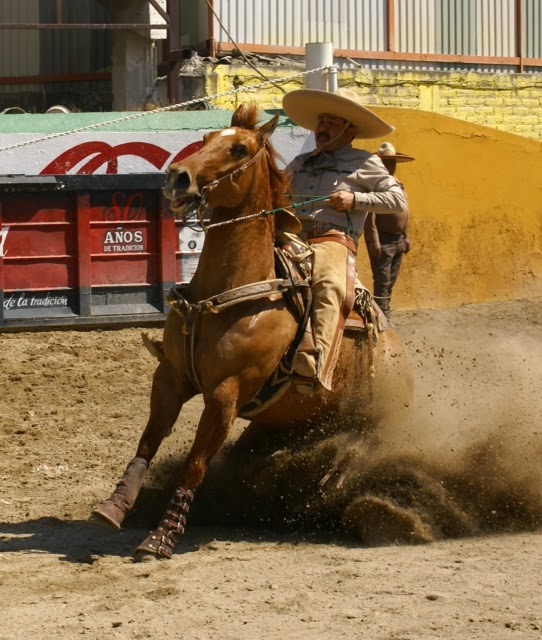
But all the events in one way or another were about riders working in intimate partnership with their mounts to perform a complicated choreographed task. One involved galloping to a chalk line, where the horse instantly lowers its hindquarters, stiffens its back legs and slides to a stop.

That's what the charro in the cribbed photo above from some other charreada is doing. (My own pictures were even worse than usual.) Judges then measure the skid marks to score the performance. The best distances while I was watching were about 16 meters.

In another phase of competition, the charro sat his horse waving a lariat and waiting for a horse to gallop past about 10 meters in front of him. His job was to toss the loop so it caught the two rear legs of his running target. I saw 15 or 20 men make the attempt. Only one missed. (The horses never went down. They just ran a few indignant tricycle strides and then kicked off the rope.)

It all looked elegant and easy. The charros in their embroidered pants, white shirts and floppy bow ties were studies in dignity and perfect posture. The horses were so casual in their discipline that it almost looked like joy. One of them even danced to the live oompah music coming from the bandstand while he waited with his rider for their event to start.

But although it looked like poetry, it was also physics. We had almost forgotten that matter in motion in these dimensions is risky for all concerned.

Then one of the tumbling bulls in the "tailing" competition apparently rolled into the right hind leg of the horse who upended him. As the charro emerged from the course, his mount limped, staggered and went over on its side.

A dozen charros immediately swarmed to the fallen horse and rider, stripped away the saddle and tack and cradled the animal's head while a veterinarian came to survey the damage.

After a minute or two, the horse struggled upright to some scattered applause, but a good part of the crowd were ranch people who knew better and watched in silence. The leg was broken right through and dangled uselessly for the few sad moments it took the horse to go down again.

The vet administered an injection, and after a short interval of waiting while it took effect, a couple of mounted charros got busy with lariats to clear the arena.

Then they struck up the band again.

Saturday, January 25, 2014

Little Green Lies


We took Elizabeth the other evening to help usher some brand new baby sea turtles into the ocean. She's got her tutu dress on, not for the occasion but because she doesn't wear much else these days. For most people, a tutu isn't an especially good look, but it works for her.

It worked especially well with the turtles, because when you're wading in the surf and need both hands free for nudging and flipping tiny wriggling creatures, you want a skirt that doesn't drag its hem. A tutu is just the thing.

"Helping" tiny olive ridley turtles through the perilous first moments of their seaborne lives is one of a growing number of experiences now being actively marketed here and throughout the destination tropics under the rubric of "eco-tourism."

You hardly need the spin to draw a crowd for a turtle launch. The little guys are so cute, waving their flippers and crawling all over each other. They look like tiny rubber wind-up toys. Who wouldn't want to give them a hand?

We were part of a van load of a half dozen or so who showed up at the hatch site in Nuevo Vallarta and found an enthusiastic throng of a hundred or more who had bought tickets at one or another of the hotels and condos that lined the beach.

They were mere tourists. As eco-tourists we sailed past the envious multitude like Paris Hilton at the Monkey Bar and entered the nursery enclosure to receive our portion of the day's hatch first.

Several things qualified us for the preferential treatment. First, we were repeatedly assured that our guide was an actual marine biologist with field research experience.

Second, although we were dying to take our bucket of babies to the water, we were treated first to a lecture on turtle life cycle, mating and reproductive habits, and the horrifying gauntlet of existential threats they run from the moment of birth and even before. Such as loss of habitat to the likes of us.

Third, our guide gave us expert instruction on how to introduce the hatchlings to the bay, casting scornful glances at the crowd of untutored hoi polloi who by now were at the water's edge yelling boisterous encouragement to their own bunch.

They had not been carefully taught, as we had, to use three fingers -- two on top, one below -- to hold the little ones, and to avoid squeezing them too hard or stepping on any turtle that got washed back to the beach.

Fourth and foremost, we paid a lot more to be there. Our guide told us our fees would help fund turtle aid projects, net only of the cost of transporting us from town.

That of course is where the eco-rubber really hit the road, or so we hope. I know there are some opportunities to join real research teams and contribute useful unskilled labor to a beneficial project.

But around here, you can be an eco-tourist just by paying a premium price to watch whales, observe young crocodiles in the tiny estuary grudgingly left untouched by developers behind the hotel zone, take a bird walk, or even to ride a zip line through a jungle canopy.

The only other requirement is willingness to spend a few solemn moments in guided consideration of how fragile is life on the planet, and to endure a small dose of guilt over your own heedless part in making it that way.

That's enough. Everybody back in the water.

Wednesday, January 22, 2014

Don't Worry, Be Happy


Small minded bureaucracy that can't get out of its own way is maddening wherever you're forced to deal with it.

And far from "changing everything," the Internet turns out to be a way for bureaucracy to continue torturing you even with no actual bureaucrats present, e.g. ObamaCare.

Imagine our surprise to discover that in Mexico, where we presumed such miseries would be squared or even cubed, the systems we've had to use -- both virtual and actual -- have so far worked the way they're supposed to, much better than we're used to in the U.S.

For example, we pay a property tax,  or predial, on our home that comes due every January. Our property manager used to pay it for us and several of our neighbors, to spare us the trouble of standing in line in the municipal building to talk with collection authorities back when our Spanish wasn't ready for prime time.

But sometimes we'd forget to remind the manager we wanted him to do this, and we'd go delinquent for several months. So a few years ago when the city put its system up online, Pam started paying it that way. I did it myself this year.

It's easy as pie, even for the idiomatically challenged, and produces a nice printable comprobante, or proof of payment document, which we occasionally need for other purposes.

Once we failed to print out the receipt, and later when we needed it we found we couldn't bring up our account on the web site. With a heavy heart I headed for the tax office, now located in a new building in a remote suburb.

But it took only minutes to find the special section that deals with online payers, and just a few minutes more for the helpful lady to fish out the original hard copy of my payment record and hand it to me with a smile.

A few weeks earlier I had the same sinking feeling as I drove to the motor vehicle office for late renewal of my Jalisco registration, recalling how our DMV back home had flogged us for weeks with our own frustration before it finally coughed up our plates.

A throng sat waiting in chairs for their turns at the window. But sing glory, it turned out not to be the window for renewals, where there was no line at all. Five minutes later I was driving home in a legal vehicle, whistling Cielito Lindo.

Our current status quest is for residente temporal visas for Pam and Elizabeth through the local immigration office, the eternal object of gringo fear and loathing. The process has been lengthy, its true. But each step has at least made sense, the waits haven't ever been long, and the national website for tracking applications has worked like a dream.

I'm sure we've been lucky. The expat blogosphere is riddled with horror stories and complaints about unresponsive or incompetent functionaries. No doubt we'll run into some of those eventually.

But I pondered all this yesterday as I was enjoying an alfresco home-delivered pedicure on the balcony and watching the bay for whales. You might think a pedicure is a little precious for a retired guy, but only ever wearing flip-flops on the uneven pavement around here is hard on our feet. Poor us.

Anyway, I had the stray thought that even if securing local documentation was a lot more infuriating and left us with a bit less time for staring into the gorgeous middle distance, it would take a singular lack of grace to bitch about it.

Tuesday, January 14, 2014

Boatloads


This huge motorsailer turned up in the Bahia de Banderas this week. I probably should have recognized her, but Pam had to tell me it was the Rainbow Warrior. Then I trained the binoculars on her and saw the enormous “Greenpeace” painted on her hull.

Watching her this morning ghosting across the bay, spreading every sail she has in the nearly nonexistent breeze, made me think about the non-stop boat show we get to see from our front porch.

I stopped gawking long enough to learn that the Warrior is touring Mexican ports to bring awareness to the environmental damage from overdevelopment in sensitive watersheds and lack of serious government efforts to regulate it. 

The ship is a spectacular sight and a perfect vessel for carrying a message of protest against abuse and neglect of the planet.

But Greenpeace isn’t the only organization that shows the flag around here to make a point or two.

The U.S. Coast Guard has sent the cutters Steadfast, Mellon, Jarrett and Alert on good will visits here. Sometimes their crews come ashore and do great volunteer work in poor neighborhoods. 

The ships themselves make dignified circuits of the bay to show off their impressive size, armament and fresh paint. I’m sure military authorities hope that smugglers are watching.

The Mexican Navy has a base north of town and a small fleet of patrol boats, some so elderly you worry for them if they venture out too far. They all make little voyages now and then past our line of sight and then head back without having done anything in particular but prove they could. Enemies of the state, ashore and afloat, beware.

Cruise ship arrivals and departures are routine, but they’re so enormous it’s nearly impossible not to stare at them. They stop short of the marina entrance to take on a port pilot. Then their vast bulk seems to slip right into the hotel skyline to the north of us and disappear. “This could be you,” is the message.

There’s another fleet that says just the opposite. These are the glossy, bulbous private and charter yachts that home port in Vallarta. Now and then somebody comes up with enough scratch to fuel one up and float it along the shoreline with a party on board, transmitting loud and clear to nearly all of us, “This couldn’t be you.”

Small sailing vessels of all kinds remind us throughout the day that life is beautiful. Hardly a happy hour goes by without at least one of them traversing the brilliant orange path that narrows across the water to the setting sun. Add a squad of pelicans and if you have a camera you have a postcard.

And after dark, the noisy pirate party ship Marigalante slips close inshore directly in front of us to launch its nightly five-rocket fireworks show. In that case, the medium really is the message.